Fidelity’s fund portfolio framework is designed to simplify one of the most complex challenges facing individual investors: building and maintaining a properly diversified investment portfolio that aligns with risk tolerance, financial goals, and time horizon. Rather than requiring investors to select and rebalance dozens of individual securities on their own, Fidelity offers structured portfolio approaches that combine multiple mutual funds into cohesive strategies.
At a high level, Fidelity provides two primary paths to diversification: customizable model portfolios and professionally managed single-fund solutions. Together, these options are intended to support both hands-on investors who want to make their own allocation decisions and those who prefer a more automated, low-maintenance approach.
Model Portfolios: A Framework for Custom Allocation
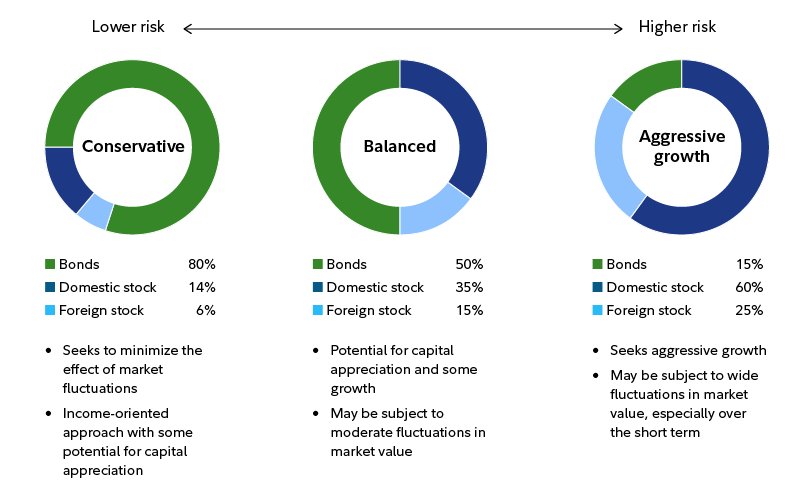
Fidelity’s model portfolios are designed as illustrative guides to help investors understand how different mixes of stocks, bonds, and short-term investments can be combined based on risk tolerance. These portfolios are not mandatory allocations but serve as reference frameworks that investors can use to construct their own portfolios using Fidelity mutual funds.
The model portfolios are organized across a spectrum of risk levels, ranging from Conservative to Most Aggressive. Each portfolio reflects a different balance between growth potential and stability:
- Conservative portfolios emphasize income and capital preservation, with a large allocation to bonds and short-term investments and a smaller allocation to domestic and international stocks. These are typically suited for investors who prioritize minimizing volatility and protecting capital.
- Moderate and Balanced portfolios aim to strike a middle ground, combining meaningful exposure to equities for growth with a substantial bond allocation to help reduce overall volatility. These models are often aligned with investors who want steady growth but are sensitive to large market swings.
- Growth and Aggressive Growth portfolios shift the balance toward equities, increasing both domestic and international stock exposure while reducing bonds and cash. These are designed for investors with longer time horizons who can tolerate higher short-term volatility in exchange for higher long-term return potential.
- Most Aggressive portfolios are heavily weighted toward equities, with little to no allocation to bonds or short-term instruments. These models are typically suited for investors who are focused on long-term capital appreciation and can withstand significant market fluctuations.
Across all risk levels, Fidelity’s models emphasize diversification not only across asset classes but also across styles, market capitalizations, and geographies. Portfolios commonly include large-cap, mid-cap, and value and growth-oriented funds, as well as international equity exposure. This structure is designed to reduce reliance on any single market segment or investment style.
Fidelity also highlights that these models are periodically reviewed and updated to reflect market conditions and evolving investment research. The goal is to maintain risk characteristics that are consistent with each target risk level, even as market dynamics change.
Asset Allocation as the Core Investment Decision
A central theme of Fidelity’s portfolio framework is the importance of asset allocation. Fidelity emphasizes that the mix between stocks, bonds, and short-term investments is one of the most important drivers of long-term portfolio behavior.
Rather than focusing solely on selecting individual funds with strong past performance, Fidelity encourages investors to start by defining their overall asset mix. This approach aligns with widely accepted investment research showing that asset allocation has a greater impact on long-term risk and return than individual security selection.
By offering predefined target asset mixes, Fidelity provides investors with a structured way to align their portfolios with their financial objectives. For example, an investor approaching retirement may favor a portfolio with higher bond exposure for income and stability, while a younger investor may prioritize growth through higher equity exposure.
Single-Fund Strategies for Hands-Off Investors
For investors who prefer not to manage multiple funds or rebalance regularly, Fidelity offers single-fund portfolio solutions that bundle diversification into one investment.
Two major categories of these single-fund strategies are:
- Fidelity Asset Manager® Funds, which provide diversified exposure across asset classes based on a selected risk level. These funds are designed to maintain a consistent asset mix over time, with Fidelity handling the ongoing rebalancing.
- Fidelity Freedom® Funds (Target Date Funds), which automatically adjust their asset allocation over time based on a target retirement year. As the target date approaches, these funds gradually shift from growth-oriented allocations toward more conservative, income-focused mixes. This “glide path” approach is intended to reduce risk as investors near retirement.
These single-fund strategies are particularly appealing for retirement accounts and long-term investors who want a simplified, professionally managed solution that evolves over time without requiring frequent manual adjustments.
Risk Management and Ongoing Rebalancing
Another key feature of Fidelity’s portfolio approach is systematic rebalancing. Over time, market movements can cause portfolios to drift away from their intended asset mix. For example, strong equity markets may increase stock exposure beyond the original target, raising overall risk.
Fidelity’s managed and model-based approaches are designed to address this issue by periodically rebalancing allocations. This process helps maintain the intended risk profile and can also encourage disciplined investment behavior by systematically trimming outperforming assets and adding to underperforming ones.
Educational and Planning Integration
Fidelity integrates its portfolio offerings with broader planning and guidance tools. Investors can access planning resources to assess goals, time horizons, and risk tolerance, helping them select an appropriate model or single-fund strategy. This planning-first approach reinforces the idea that portfolio construction should be driven by personal financial circumstances rather than short-term market trends.
A Framework for Long-Term Discipline
Overall, Fidelity’s fund portfolio structure reflects a long-term, process-driven investment philosophy. By emphasizing diversification, asset allocation, and disciplined rebalancing, Fidelity aims to help investors stay aligned with their goals through different market cycles.
Rather than promoting tactical trading or market timing, the framework is designed to support steady, goal-oriented investing. For many investors, particularly those saving for retirement or long-term objectives, this structured approach can reduce complexity, improve consistency, and increase the likelihood of staying invested during periods of market volatility.
In an environment where financial markets can be highly volatile and information overload is common, Fidelity’s portfolio solutions are positioned as a way to bring clarity, structure, and long-term focus to personal investing—helping investors translate broad financial goals into practical, diversified investment strategies.