For much of the past two decades, and with renewed vigor in 2026, headlines have periodically declared the imminent “death of the dollar.” The argument is familiar: rising U.S. government debt, the weaponization of the dollar through sanctions, and the emergence of rival power blocs such as BRICS are supposedly eroding the greenback’s dominance. Add to this the hype around China’s digital yuan, and the conclusion often seems foregone—America’s currency is living on borrowed time.
Yet a closer look reveals a far more complex, and far less dramatic, reality. De-dollarization is indeed happening—but slowly, unevenly, and largely at the margins. Far from collapsing, the U.S. dollar remains the undisputed backbone of what economists might call the “global commons”: the shared financial infrastructure that underpins trade, investment, and capital flows across borders.
The Narrative of Decline
The de-dollarization narrative rests on three main pillars.
First, U.S. sanctions. Over the past decade, Washington has increasingly used its control over dollar clearing systems and financial infrastructure as a tool of foreign policy. From Iran to Russia, countries targeted by sanctions have faced exclusion from dollar-based payment networks, most notably SWIFT. Critics argue this has incentivized affected nations—and even neutral ones—to seek alternatives in order to reduce vulnerability to U.S. pressure.
Second, debt and deficits. U.S. federal debt has surpassed levels once considered unthinkable, while persistent fiscal deficits raise long-term questions about sustainability. Skeptics claim that excessive borrowing will eventually undermine confidence in U.S. Treasuries, the bedrock of the dollar system.
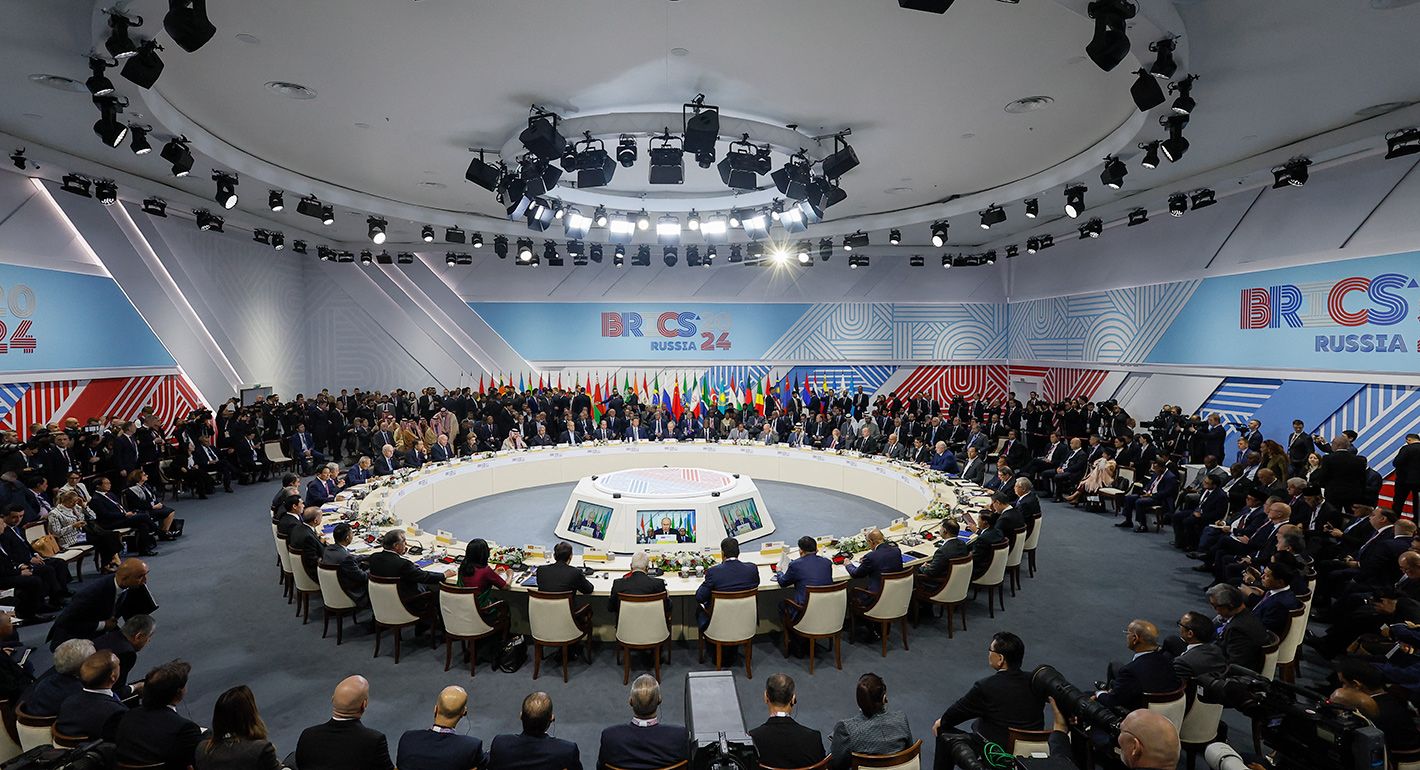
Third, geopolitics. The rise of China and the reassertion of non-Western powers have fueled talk of a multipolar world, including a multipolar currency order. BRICS discussions of local-currency trade settlement, China’s promotion of the yuan in energy markets, and experiments with central bank digital currencies (CBDCs) are often presented as evidence that a post-dollar era is already taking shape.
Taken together, these trends make for compelling headlines. But headlines are not the same as structural change.
The Sticky Reality of the Dollar System
In practice, the dollar’s dominance has proven remarkably resilient.
At the core of this resilience lies a powerful network effect. Most global trade in commodities—from oil and gas to grains—is priced and settled in dollars. More importantly, the majority of global debt, including sovereign debt in emerging markets and corporate borrowing worldwide, is denominated in dollars. This creates a self-reinforcing loop: to service dollar-denominated obligations, governments and firms must earn or acquire dollars, which in turn sustains global demand for the currency.
Breaking such a network effect is extraordinarily difficult. Even countries that openly seek to reduce dollar dependence often find themselves constrained by existing liabilities and market realities. Trading oil in yuan, for example, may reduce dollar usage at the margin, but it does little to change the underlying structure of global finance.
Trust, Law, and Liquidity
Beyond network effects, the dollar benefits from something far harder to replicate: trust.
Investors around the world place unparalleled confidence in the U.S. legal system and institutional framework. Property rights, contract enforcement, and judicial independence are not abstract ideals; they are practical considerations that determine where capital flows in times of uncertainty. When crises hit—whether financial, geopolitical, or pandemic-related—capital does not flee the United States. It floods in.
This trust is closely tied to liquidity. The U.S. Treasury market is the deepest and most liquid financial market on Earth. It offers investors the ability to move vast sums of money quickly, transparently, and with minimal risk. No other country comes close. The euro area lacks a unified fiscal authority and a single safe asset comparable in scale to U.S. Treasuries. China’s bond markets, while growing, remain constrained by capital controls and limited transparency.
In moments of global stress, these differences matter. The dollar’s dominance is not just about habit; it is about functionality under pressure.
The Limits of Alternatives
Proponents of de-dollarization often point to alternatives such as the euro, the yuan, or even a hypothetical BRICS currency. Each, however, faces significant limitations.
The euro is the most plausible challenger, yet it suffers from structural fragmentation. Without a true fiscal union, the eurozone cannot issue debt at scale with the same risk-free perception as U.S. Treasuries. The sovereign debt crisis of the 2010s left lasting scars on investor confidence.
The Chinese yuan, digital or otherwise, faces even steeper obstacles. China maintains strict capital controls, limiting the free movement of money across borders. Its financial system is closely intertwined with the state, and legal protections for foreign investors are widely viewed as weaker and less predictable than in advanced Western economies. These factors fundamentally constrain the yuan’s appeal as a global reserve currency.
As for a BRICS currency, the idea remains more political slogan than economic reality. The bloc’s members differ widely in economic structure, inflation histories, and geopolitical priorities. Creating a shared currency—or even a widely used settlement unit—would require levels of coordination and trust that are currently absent.
Diversification, Not Displacement
What is happening, then, if not the “death of the dollar”?
The more accurate description is currency diversification. Countries are gradually increasing the use of local currencies in bilateral trade, building regional payment systems, and modestly adjusting the composition of their foreign exchange reserves. These steps are rational responses to geopolitical risk and financial prudence, not revolutionary acts.
Importantly, diversification does not require the displacement of the dollar. A world in which the dollar accounts for, say, 50 percent of global reserves instead of 60 percent would still be a dollar-centric world. Dominance is not binary; it exists on a spectrum.
History supports this view. The British pound did not lose its global role overnight when the United States rose to prominence. The transition took decades, and even then, it coincided with two world wars and the collapse of Britain’s economic base. No comparable shock is currently visible for the United States.
The Dollar’s Enduring Role
The dollar’s role as the world’s primary reserve currency is ultimately rooted in the broader strength of the U.S. system: its economy, institutions, military power, and capacity for innovation. While each of these faces challenges, together they still form a foundation unmatched by any rival.
This does not mean the United States can be complacent. Fiscal discipline, institutional credibility, and openness to global capital are not guaranteed forever. The dollar’s dominance is durable, but not indestructible.
For now, however, reports of its demise are greatly exaggerated. De-dollarization is real, but incremental. The dollar remains the central pillar of the global financial system—less a fading empire than a well-worn bridge that, despite its flaws, no one has yet managed to replace.
In 2026, the story is not the death of the dollar. It is the persistence of a system that, for all its critics, still works better than the alternatives.