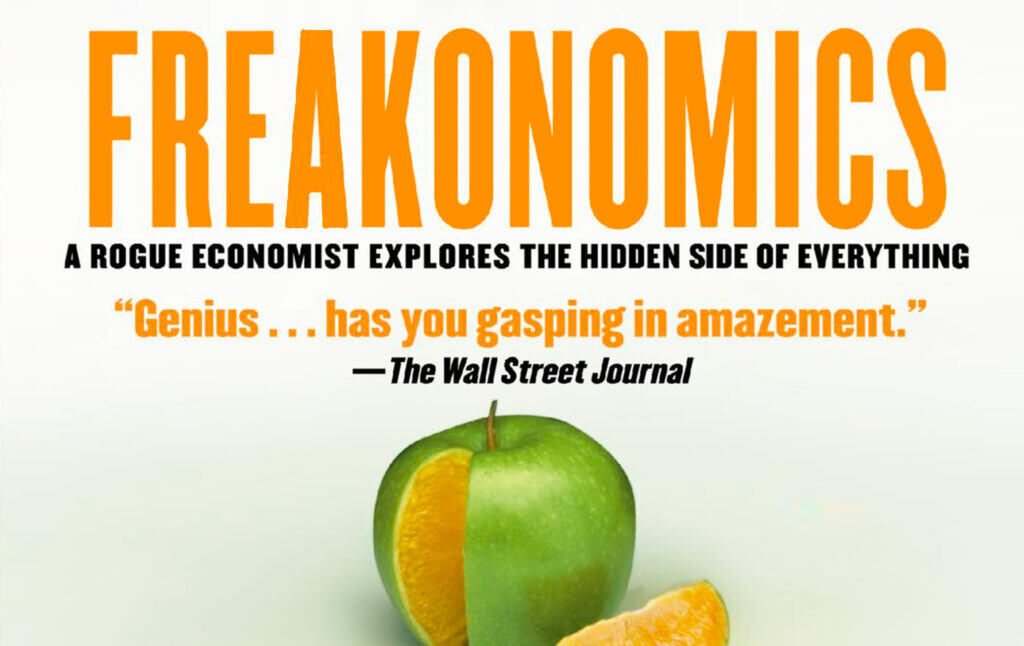
Freakonomics, written by economist Steven D. Levitt and journalist Stephen J. Dubner, became a cultural phenomenon by presenting economics not as a dry study of markets and money, but as a way of thinking about human behavior. Through a series of unconventional case studies, the book argues that economic tools—particularly incentives, data analysis, and cost-benefit thinking—can be applied to everyday life, from parenting and education to crime and cheating.
The book’s popularity stems from its ability to make economic reasoning accessible and entertaining. However, from an economist’s perspective, many of its arguments have also attracted serious criticism, particularly regarding methodology, causal inference, and the limits of applying economic models to complex social phenomena.
Core Ideas and Appeal
Incentives as a Central Driver of Behavior
One of the book’s central themes is that people respond strongly to incentives—financial, social, and moral. Levitt and Dubner argue that understanding incentives helps explain a wide range of behaviors, from why teachers might cheat on standardized tests to why drug dealers often live with their parents.
This framing is grounded in standard economic theory. Incentives are a foundational concept in economics, and the book does a good job of illustrating how poorly designed incentives can lead to unintended consequences. By showing how people respond to the structure of rewards and punishments, Freakonomics helps readers appreciate the hidden side of policy design.
However, critics argue that the book sometimes overstates the explanatory power of incentives, underplaying cultural, institutional, and psychological factors that also shape behavior. Not all human decisions can be reduced to simple incentive optimization, and overemphasis on this lens can lead to overly narrow interpretations of complex social issues.
Data as a Tool for Uncovering Hidden Patterns
Another major contribution of Freakonomics is its emphasis on using large datasets to uncover patterns that are not immediately obvious. The book popularized the idea that creative use of data can reveal surprising correlations and challenge conventional wisdom.
This data-driven approach helped bring empirical microeconomics to a broader audience. It also anticipated the growing importance of “big data” and applied econometrics in policy analysis and business decision-making.
From an academic standpoint, however, the book sometimes blurs the line between correlation and causation. While Levitt is a highly respected empirical economist, some of the book’s popularized examples simplify or overstate the strength of causal claims, which can mislead non-expert readers.
The Crime Decline and Abortion Hypothesis
Perhaps the most controversial argument in Freakonomics is the claim that the legalization of abortion in the United States contributed significantly to the decline in crime in the 1990s. The authors argue that unwanted children are more likely to grow up in adverse environments and, statistically, more likely to engage in criminal behavior. Therefore, increased access to abortion reduced the number of high-risk births, leading to lower crime two decades later.
This hypothesis generated enormous debate within economics, criminology, and public policy. While the original research sparked important discussion, many subsequent studies have questioned the strength and robustness of the results. Critics point out that crime trends were influenced by many factors, including improved policing strategies, incarceration rates, demographic shifts, economic growth, and the removal of lead from gasoline.
From an economist’s perspective, the main critique is that the book presents a complex and contested empirical finding with a level of confidence that is not fully justified. The causal chain is difficult to establish definitively, and later research has produced mixed or contradictory results.
Education and Parenting: Signaling vs. Causation
The book also examines education and parenting, arguing that many commonly believed drivers of child success—such as involved parenting behaviors—may be less important than underlying family characteristics like income, education, and stability. The authors suggest that much of what appears to be effective parenting may simply be correlated with these deeper factors.
Economists generally agree with the distinction between correlation and causation, and the book does well to challenge simplistic narratives about what “works” in education. However, critics argue that Freakonomics can come across as dismissive of the role of schools, teachers, and parenting interventions.
From a policy standpoint, this framing risks being misinterpreted as implying that education policy or parenting practices matter little, which is not supported by the broader education economics literature. While family background is highly influential, targeted interventions and school quality have also been shown to produce meaningful long-term effects.
Methodological Critiques from Economists
Overreliance on Clever Identification
Many of the book’s case studies rely on creative statistical identification strategies. While this is a strength in academic research, in a popular book format, the nuances and limitations are often glossed over. This can create the impression that the conclusions are more definitive than they really are.
Economists emphasize that empirical results depend heavily on assumptions, model specifications, and data quality. When these details are simplified for mass audiences, readers may not appreciate the degree of uncertainty involved.
Selection Bias and Omitted Variables
Several Freakonomics examples have been criticized for potential selection bias and omitted variable problems. In complex social systems, it is difficult to isolate one factor without accounting for many others. Critics argue that some of the book’s conclusions may be sensitive to unobserved variables that are not fully controlled for.
The Risk of Storytelling Economics
One of the book’s greatest strengths—its storytelling—can also be a weakness. By presenting findings as engaging narratives, Freakonomics sometimes encourages readers to remember the story more than the statistical caveats. This can lead to overgeneralization and misapplication of results to contexts where they may not apply.
Overall Assessment
From an economist’s point of view, Freakonomics is best seen as a gateway book rather than a definitive guide to economic thinking. It succeeds brilliantly in showing that economics is not just about markets, but about human behavior, incentives, and data. It has inspired many students to study economics and has helped popularize empirical methods.
At the same time, the book’s popular format necessarily sacrifices nuance. Some of its most famous claims remain controversial, and its tendency to present provocative correlations as near-causal explanations has drawn justified criticism within the profession.
In the end, Freakonomics is valuable for sparking curiosity and encouraging readers to question conventional wisdom. But from a professional economics perspective, its conclusions should be treated as conversation starters, not settled facts. For readers seeking to apply its lessons to policy or personal decision-making, it is essential to supplement the book with more rigorous, evidence-based economic research and a healthy skepticism about simple explanations for complex social outcomes.