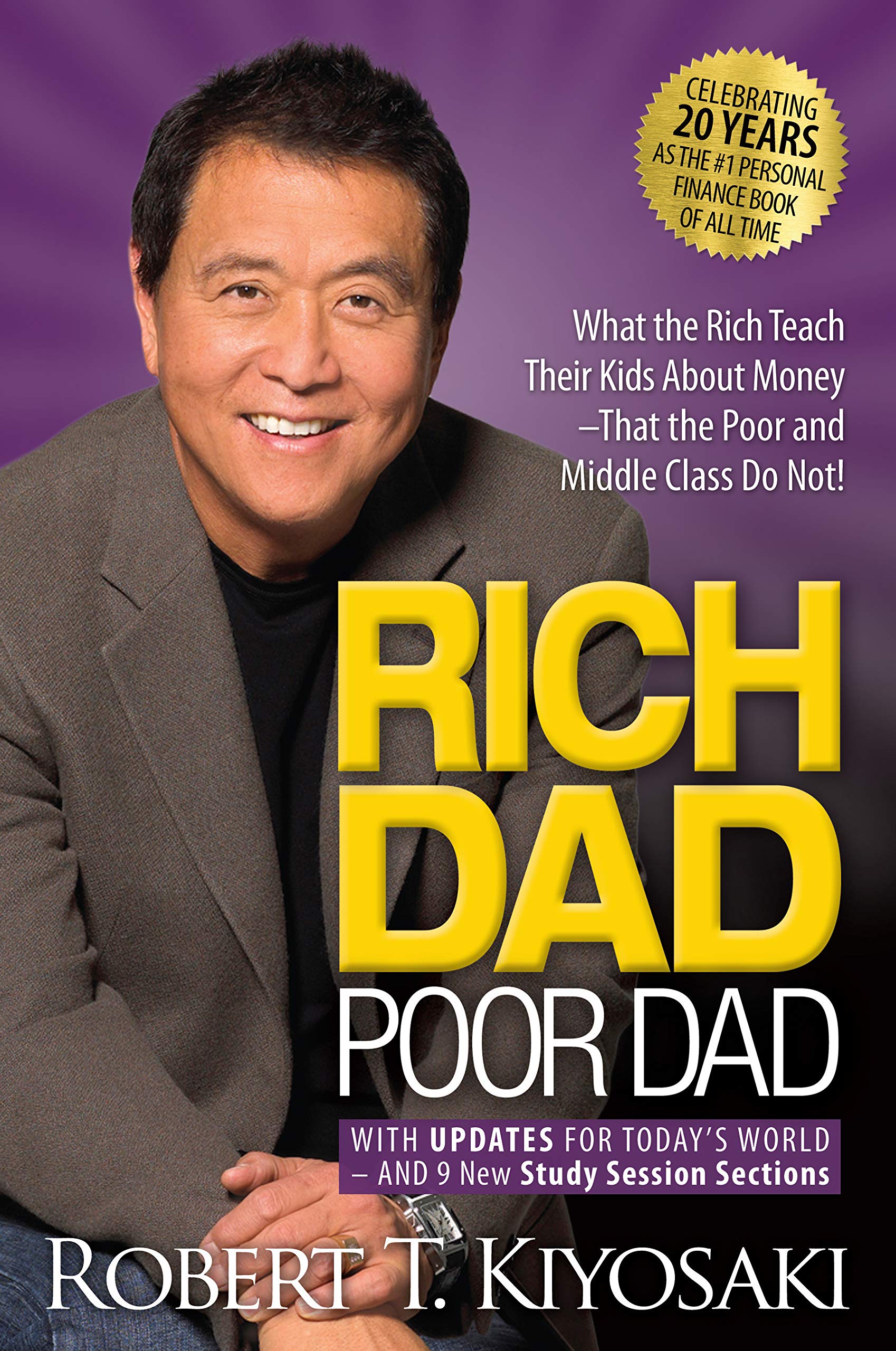
Robert T. Kiyosaki’s Rich Dad Poor Dad is one of the most influential personal finance books of the past several decades. Framed as a set of life lessons learned from two father figures—his biological father (“Poor Dad”) and the father of his childhood friend (“Rich Dad”)—the book challenges conventional thinking about money, work, and education. Its core message is that financial success depends less on earning a high salary and more on how individuals think about money, assets, and financial independence.
While the book has inspired millions to take a more active role in their financial lives, it has also drawn significant criticism for oversimplification, questionable examples, and advice that can be risky if followed without context.
Core Themes and Lessons
1. The Difference Between Assets and Liabilities
One of the book’s most famous teachings is Kiyosaki’s definition of assets and liabilities. He defines an asset as something that puts money in your pocket and a liability as something that takes money out. Under this framework, rental properties, businesses, stocks, and intellectual property are assets, while personal residences, car loans, and consumer debt are often categorized as liabilities.
This simplified definition is meant to shift readers’ focus from traditional status symbols to cash-flow-producing investments. The broader lesson is sound: building income-generating assets is essential for long-term financial independence. However, critics argue that Kiyosaki’s definition is nonstandard and can be misleading. For example, a primary residence may not produce cash flow, but it can still be a long-term store of value, a hedge against rent inflation, and a forced savings mechanism.
2. The Importance of Financial Education
Kiyosaki strongly criticizes traditional schooling for failing to teach practical financial skills. He argues that many highly educated people struggle financially because they were never taught about cash flow, taxes, investing, and business ownership.
The book encourages readers to seek financial education outside formal institutions by reading books, attending seminars, and learning directly from investing experiences. This emphasis on financial literacy is one of the book’s most widely praised aspects. Understanding basic concepts such as balance sheets, income statements, and cash flow is undeniably valuable.
At the same time, the book often implies that formal education is of limited value for wealth creation. This framing can be misleading. In reality, higher education and professional skills often provide the income stability and capital that make investing possible in the first place.
3. Working to Learn, Not Just to Earn
Another key message is that people should choose jobs not only for salary, but also for the skills they teach. Kiyosaki advocates learning sales, marketing, accounting, and investing, even if it means accepting lower pay initially.
This idea promotes a long-term mindset and skill accumulation, which can be valuable. However, for many readers—especially those with limited financial safety nets—taking lower pay for “learning” can be impractical or risky. The advice is most applicable to people who already have some financial stability or alternative support.
4. Entrepreneurship and Passive Income
Kiyosaki presents entrepreneurship and investing as the primary paths to wealth, contrasting them with traditional employment. He emphasizes building businesses and acquiring income-producing assets that generate cash flow without active daily involvement.
The appeal of passive income is powerful, and the concept has motivated many readers to explore real estate, small businesses, and investing. However, the book often understates the risks, effort, and capital required. In reality, most businesses and real estate ventures require significant time, management, and expertise, especially in their early stages.
5. Mindset Over Mechanics
Throughout the book, Kiyosaki emphasizes mindset: thinking differently about money, embracing calculated risk, and overcoming fear of failure. He argues that many people remain financially stuck because of fear, lack of confidence, and a scarcity mindset.
This psychological framing is one of the book’s strengths. Money decisions are deeply influenced by beliefs and emotions, and encouraging readers to reflect on their attitudes toward risk and opportunity can be genuinely helpful.
Critique of Robert Kiyosaki and His Advice
Despite its motivational impact, Rich Dad Poor Dad has attracted substantial criticism from financial professionals and academics.
1. Questionable Real-World Examples
One of the most common criticisms is that the “Rich Dad” character may be partly fictional or at least heavily dramatized. Kiyosaki has provided inconsistent accounts of who Rich Dad was and what he did. This raises concerns about how literally readers should take the stories and lessons.
If the foundational narrative is not fully grounded in verifiable reality, it weakens the credibility of some of the book’s claims.
2. Oversimplification of Investing
The book often presents investing—especially real estate—as more straightforward and accessible than it is for most people. It downplays risks such as market downturns, vacancy rates, leverage, legal issues, and liquidity constraints.
Readers who follow the book’s encouragement to use debt aggressively to acquire assets may expose themselves to significant financial risk, particularly in volatile or declining markets. High leverage can amplify gains, but it can also lead to rapid financial ruin if cash flow falls or asset values decline.
3. Promotion of High-Risk Behavior
Kiyosaki frequently criticizes conservative saving and emphasizes taking risks. While calculated risk-taking is essential for growth, the book can be interpreted as encouraging reckless behavior, especially by inexperienced investors.
For individuals without emergency savings, stable income, or financial knowledge, jumping into leveraged real estate or speculative investments can be dangerous. Many critics argue that Kiyosaki underemphasizes the importance of financial cushions, diversification, and downside protection.
4. Conflicts of Interest and Upselling
Kiyosaki’s brand extends far beyond the book into seminars, coaching programs, games, and paid courses. Critics have noted that some of these offerings are expensive and of questionable value. This has led to accusations that the book functions partly as a marketing funnel for higher-priced products.
This commercial ecosystem complicates the book’s message, as readers may be encouraged to spend significant money on education products rather than focusing on low-cost, evidence-based financial learning.
5. Lack of Evidence-Based Guidance
Unlike many modern personal finance authors, Kiyosaki rarely cites academic research or long-term data. His advice is largely anecdotal and philosophy-driven. While this makes the book accessible and motivational, it also means that many claims are not rigorously supported.
Overall Assessment
Rich Dad Poor Dad is best understood as a mindset book rather than a technical investing guide. Its greatest value lies in encouraging readers to think differently about money, question traditional assumptions, and take responsibility for their financial education.
However, the book’s practical advice should be treated with caution. Its simplified asset definitions, optimistic portrayal of entrepreneurship, and aggressive stance on leverage can lead readers to underestimate risk. For many people, a more balanced approach—combining stable income, disciplined saving, diversified investing, and gradual skill development—may be safer and more effective.
In short, Rich Dad Poor Dad can be a useful starting point for changing how people think about money, but it should not be treated as a complete or reliable roadmap to wealth. Readers are best served by pairing its motivational lessons with evidence-based financial planning and a realistic assessment of their own risk tolerance and circumstances.